LLM latency benchmarking: TTFT, throughput, and the long tail
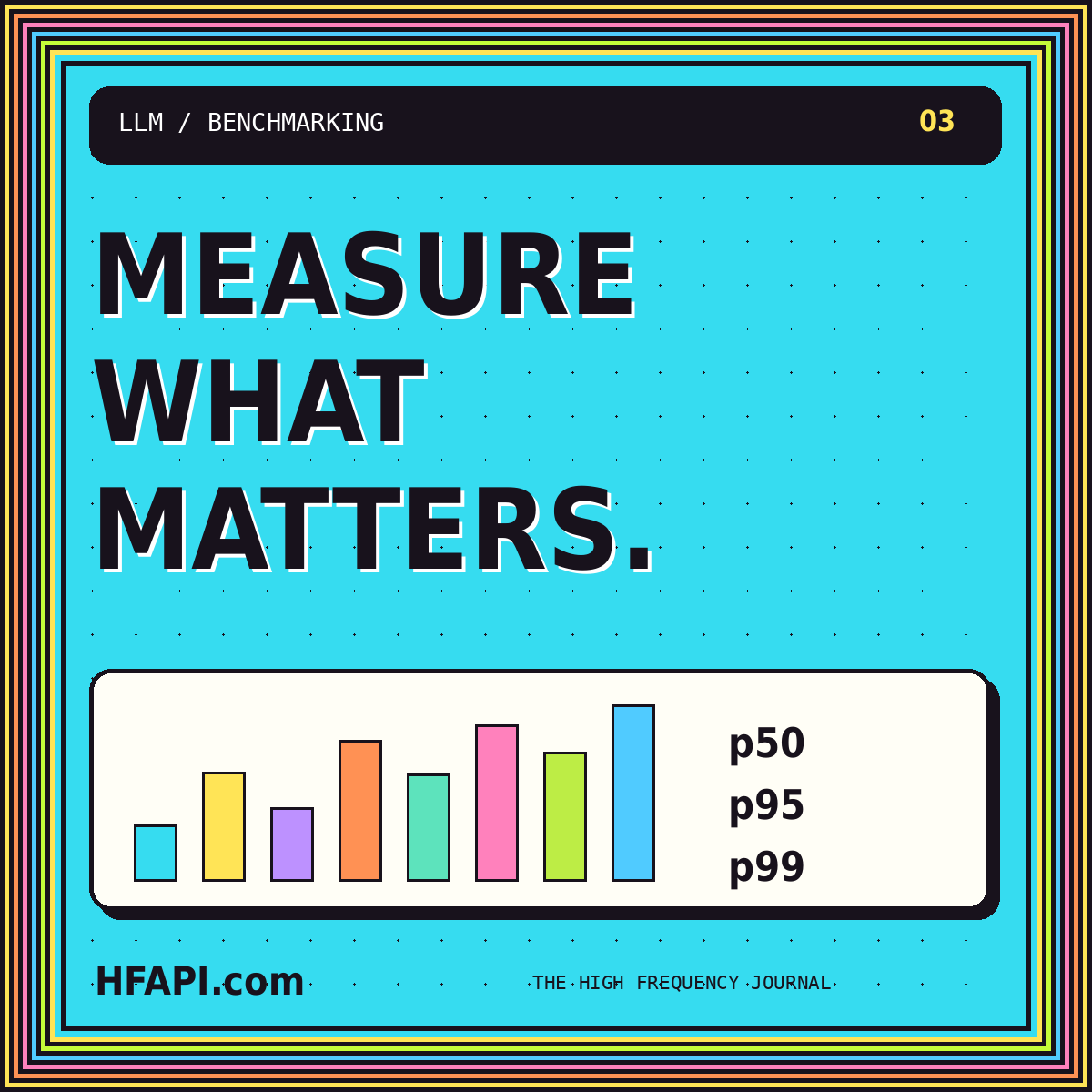
Measure first content, full completion, quality, and failures without hiding the conditions behind the numbers.
Your independent guide to high frequency APIs, Hugging Face models, responsive LLMs, and thoughtfully engineered trading research.
Different meanings of “HF.” One place to make sense of them. Start with the part of the stack you’re building.
Design for throughput without losing the plot. Deadlines, backpressure, streaming, and reliable request handling.
Make your first model call with a clear route, protected credentials, and an output you actually validate.
From model cards to task-based evaluation. Build a shortlist around your needs, not a leaderboard position.
Understand first-token latency, token throughput, caching, and the tradeoffs behind responsive inference.
Explore market-data freshness, order state, and risk controls—with research outside the execution path.
Use LLMs to assist research, preserve evidence, challenge a hypothesis, and make testing more rigorous.
A useful integration begins with one bounded request—not a wall of SDK magic. Follow the path from a model choice to a validated answer.
A model repository is not the same as a hosted API.
Run examples locally. Never put tokens in browser code.
A successful request does not guarantee a useful answer.
import json, os, urllib.request

url = "https://router.huggingface.co/v1/chat/completions"
body = {
    "model": os.environ["HF_MODEL"],
    "messages": [{"role": "user", "content": "Explain latency."}],
    "max_tokens": 128,
}
request = urllib.request.Request(
    url, data=json.dumps(body).encode(),
    headers={
        "Authorization": "Bearer " + os.environ["HF_TOKEN"],
        "Content-Type": "application/json",
    },
)
with urllib.request.urlopen(request, timeout=30) as response:
    result = json.load(response)
print(result["choices"][0]["message"]["content"])
# Trusted terminal only. Set HF_TOKEN and HF_MODEL first.
python3 -c 'import json, os; print(json.dumps({
"model": os.environ["HF_MODEL"],
"messages": [{"role": "user", "content": "Explain latency."}],
"max_tokens": 128
}))' | curl --fail-with-body --max-time 30 \
https://router.huggingface.co/v1/chat/completions \
-H "Authorization: Bearer $HF_TOKEN" \
-H "Content-Type: application/json" \
--data-binary @-
# A response is generated text, not an approved action.
# See the downloadable Python example for validation.
Interested in high frequency trading AI? Start by separating what a model can suggest from what a system is allowed to do.
Use an LLM to organize documents, surface evidence, and help examine a hypothesis. Keep source data, review, and reproducibility in the loop.
Study data freshness, pre-trade checks, order state, and reconciliation. In our reference architecture, model calls stay outside the order path.
Educational architecture only. No trading signals, execution services, or performance guarantees. Trading can result in loss. Read the full notice.
Measure first content, full completion, quality, and failures without hiding the conditions behind the numbers.
Keep credentials out of browsers, narrow permissions, minimize logs, and require authorization before models act.
Use models for bounded research while preserving evidence, point-in-time data, testing discipline, and review.
Not another black box. Here’s what HFAPI is—and what it isn’t.
An independent learning hub for API engineering, Hugging Face integrations, model evaluation, and trading-system research. We publish guides and local examples—not a hosted API product.
Both appear in our coverage, but they describe different things. High frequency concerns request or event workloads. Hugging Face is a separate model and tooling ecosystem. Start with our glossary to connect the terminology.
No. HFAPI.com does not issue provider credentials or collect your tokens. Our quickstart explains how to use your own authorized provider access in a trusted local environment.
No. Trading content is educational and focuses on research discipline, architecture, and controls. We do not recommend trades or predict returns. Read our risk disclosure.
Start with the Hugging Face API overview, run a small local example, then explore measurement and security. No signup is required to read any guide.
Found an error or have a technical topic we should cover?